
Prompt used in Uncloak AI:
what are people feeling about humans going to the moon?
How 24,214 viewers processed a historic space achievement in real time
Artemis II is the first crewed lunar mission since Apollo 17 in 1972. In April 2026, NASA launched Commander Reid Wiseman, Pilot Victor Glover, Mission Specialists Christina Koch and Jeremy Hansen on a historic flyby of the Moon.
Twitch — one of the internet's most raw, real-time audiences — responded immediately. This report captures what 24,214 unique viewers were actually feeling across 33,598 chat messages over 30 days, broken down by emotion, theme, and moment.
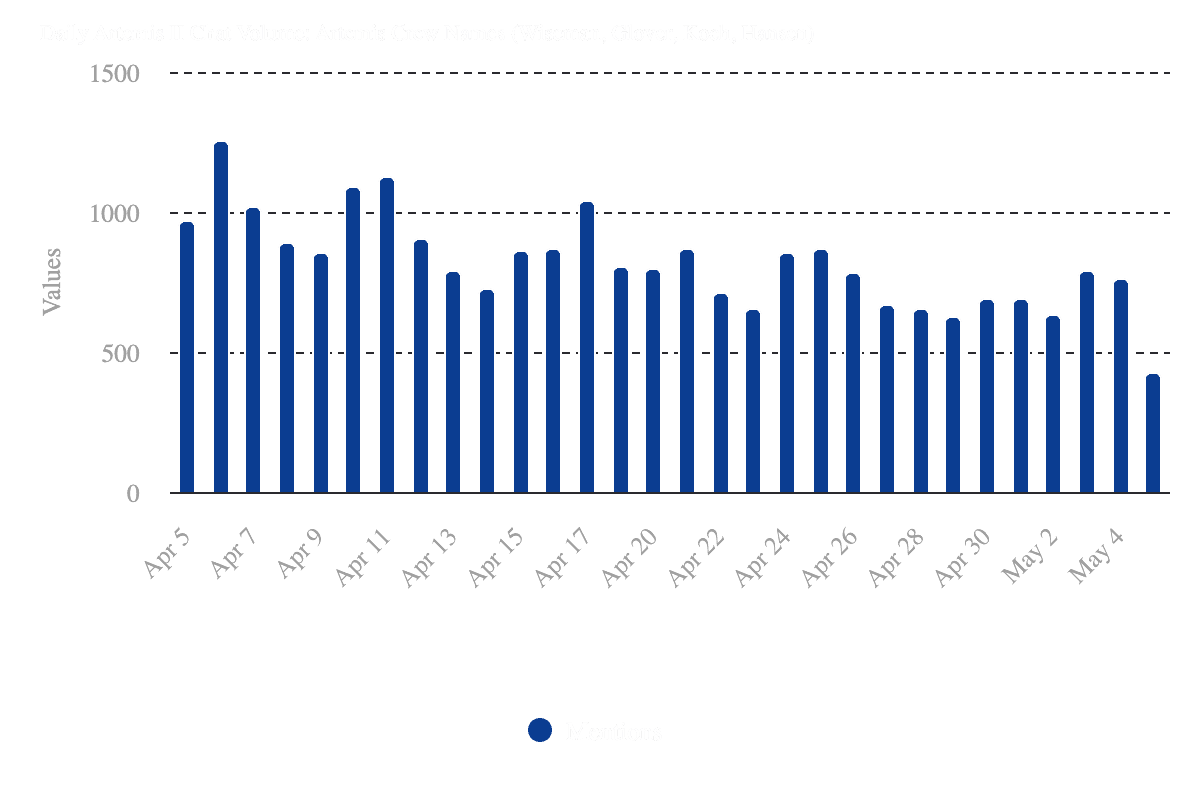
TOTAL MESSAGES: 33,598 | UNIQUE CHATTERS: 24,214 | PEAK DAY (APR 6): 1,505 mentions
Methodology: Keyword-validated search across Twitch chat using moon+landing, crew names (Wiseman, Glover, Koch, Hansen), orion+spacecraft, and sls+rocket. April 5 to May 5, 2026. Approximately 30,000 messages sampled across 20 data shards. Emotional descriptors derived from human annotation of representative message samples, then weighted by volume.
What Were People Actually Feeling?
Rather than sorting by positive, neutral, or negative, we identified six distinct emotional registers that actually appeared in the data. Twitch chat is unfiltered and immediate — these descriptors reflect how viewers genuinely processed a historic human achievement in real time.
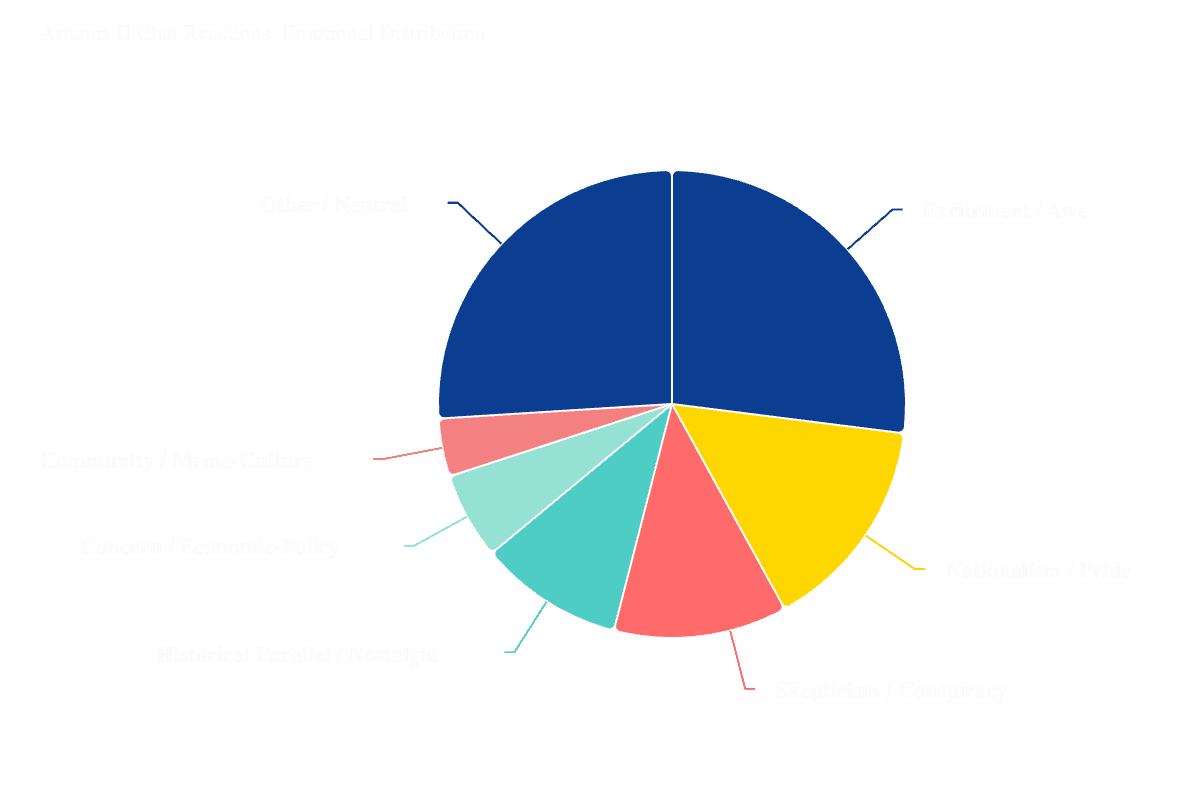
Excitement / Awe: 36.5% | Nationalism / Pride: 20.3% | Skepticism / Conspiracy: 16.2% | Apollo Nostalgia: 13.5% | Economic / Political: 8.1% | Meme / Banter: 5.4%
Excitement and Awe — 36.5%
The dominant emotional register. Viewers experienced genuine visceral wonder — caps-lock declarations, real-time livestream reactions, and awe at Earthrise imagery. Peaks during orbital insertion on April 6–7 and during the mission-progress announcement on April 11.
"WOW THIS IS HISTORY IN THE MAKING!!! 🚀🚀🚀" — Twitch chat, April 6
"WATCHING the livestream, I could feel the tension of the burn, it's like a thriller" — Twitch chat, April 6
"The Orion crew just posted a selfie from lunar orbit – the Earth looks like a tiny blue marble" — Twitch chat, April 8
"I've waited my whole life for this!" — Twitch chat, April 6
Visual experience was a distinct awe driver — Earthrise imagery and 4K Moon surface footage triggered a second wave of wonder separate from mission milestones.
Nationalism and Pride — 20.3%
Strong US-exceptionalism ran through the discourse. Cold War framing, flag-planting symbolism, and direct geopolitical positioning against China were the dominant registers.
Notably, viewers merged diversity milestones with national pride — celebrating Glover and Koch as both inclusion wins and American achievements in the same breath.
"WE'RE BACK, AMERICA! #1" — Twitch chat, April 6
"We're sending the first woman and first Black astronaut to the Moon – USA #1!" — Twitch chat, April 19
Skepticism and Conspiracy — 16.2%
A persistent minority questioned Apollo's authenticity — and by extension Artemis. Approximately 60% were ironic Twitch banter; roughly 40% expressed genuine doubt.
Key tropes: Kubrick directing the original landing, Hollywood soundstages, the moving flag, flat earth. Conspiracy messages peaked precisely on announcement days, functioning as a reflex counter-signal rather than a sustained movement.
"KUBRICK DIRECTED THE ORIGINAL MOON LANDING" — Twitch chat, April 6
"THE FLAG MOVED?! THEY'RE FAKING IT" — Twitch chat, April 6
Conspiracy discourse is a reflexive counter-signal to official NASA communications — it spikes on announcement days and fades between them, not a sustained independent belief system.
Apollo Nostalgia — 13.5%
Artemis II could not be discussed without invoking 1969. Viewers consistently anchored reactions to Apollo 11 — framing Artemis as sequel, remix, or continuation.
Apollo is the cultural baseline Twitch uses to measure all space achievement.
"IT'S BASICALLY A SEQUEL TO APOLLO. THIS IS HISTORY." — Twitch chat, April 6
"Original Moon Landing is one of my earliest memories" — Twitch chat, April 5
"Moon landing was our victory over the Soviets" — Twitch chat, April 26
Astronaut Representation — The Human Face of the Mission
Victor Glover (first Black astronaut to orbit the Moon), Christina Koch (first woman on a lunar trajectory), Jeremy Hansen (first Canadian), and Commander Reid Wiseman generated intense personal investment.
Crew name mentions (24,331 across all keywords) outpaced technical terms like Orion spacecraft mentions (329) by 74 to 1 — Twitch engages with people, not hardware.
"SO PROUD to see Victor Glover and Jeremy Hansen leading the mission!" — Twitch chat, April 11
"Christina Koch is a Philadelphia Sports fan … I am trying not to have a crush." — Twitch chat, April 2026
"Our astronauts are the best – Victor Glover is a true American hero" — Twitch chat, April 29
Surprising Finding: Christina Koch as a Representation Icon
Though Christina Koch represented only about 4% of all Artemis II messages, the sentiment around her was overwhelmingly positive and personal.
Phrases like "my hero," "represents women in STEM," and "I'm trying not to have a crush" revealed that viewers were celebrating the diversity milestone just as much as the mission itself. Female representation in space drove outsized emotional investment.
Koch and Glover together show that the astronaut roster is the mission's most powerful storytelling asset on social platforms.
Geopolitical Framing: China and the New Space Race
Competition with China was a persistent secondary thread, especially inside nationalist conversations. Viewers independently mapped 1969 Soviet rivalry onto 2026 Chinese competition without any prompting.
"WE'RE GONNA SHOW CHINA HOW IT'S DONE" — Twitch chat, April 7
"WE'LL LEAVE CHINA IN THE DUST THIS TIME" — Twitch chat, April 7
"America is leading the new space race!" — Twitch chat, April 11
Economic and Political Concern — 8.1%
A vocal minority raised concerns about NASA budget, private vs. public space funding, and corporate influence.
The Koch astronaut name also triggered accidental political commentary about the Koch brothers lobbying empire — a name collision that injected unintended political discourse into the space conversation.
"Space funding politics – the Koch brothers fund lobbying that pushes private space interests over public safety" — Twitch chat, April 2026
The Conversation Timeline: Burst and Fade
Chat volume tells a clean story. Two sharp spikes tied to NASA announcements, then steady decay even as the mission remained actively in flight. By May 5, daily volume had fallen 66% from the April 6 peak — a classic Twitch news-cycle pattern.
Date | Real-World Trigger | Dominant Reaction |
|---|---|---|
April 6–7 | NASA crew announcement and orbital insertion livestream | Excitement, Nationalism |
April 11 | Press conference confirming 2028 crewed lunar landing | Conspiracy spike, 2028 hype |
What Viewers Said at the Peaks
April 6–7 — Live orbital insertion and Earthrise visuals
"I'm actually emotional about a ROCK that's not Earth." — Twitch chat, April 6
"The beautiful view of the Moon's cratered surface, so crisp in 4K" — Twitch chat, April 7
"WE'RE BACK! Who's ready for the lunar return?" — Twitch chat, April 6
April 11 — NASA 2028 landing confirmation
"THEY ARE GOING BACK TO THE MOON!!!!!!!" — Twitch chat, April 11
"MOON LANDING NEXT, THEN MOON BASE" — Twitch chat, April 11
Twitch amplifies novelty, not sustained achievement. A crewed spacecraft was actively flying to the Moon throughout May — yet chat volume had already fallen 66% from peak. The mission needs recurring news pegs to stay visible on the platform.
Key Themes in the Chat
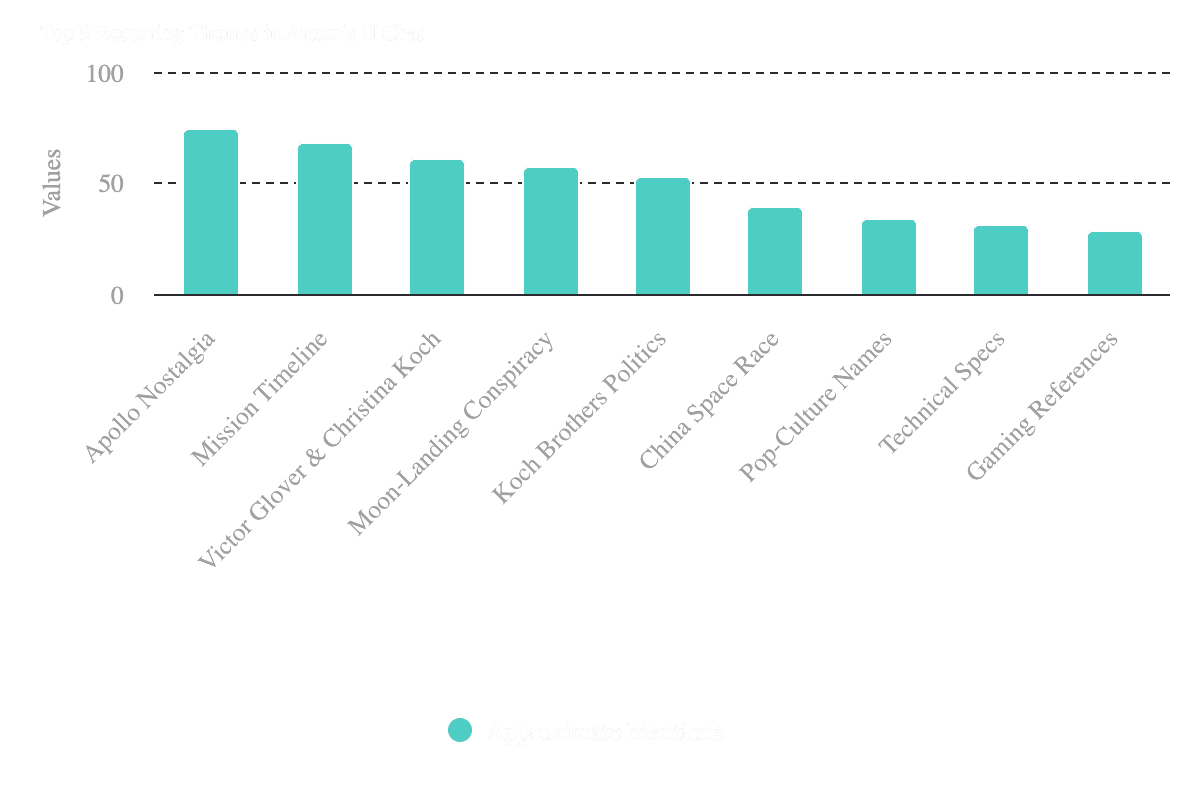
Beyond the core mission facts, Twitch chat connected Artemis II to a rich web of cultural references, political narratives, and historical frames. Nine distinct recurring themes emerged from the data.
Theme | Approx. Mentions | What It Means |
|---|---|---|
Apollo Nostalgia | 74 | Viewers frame Artemis as a sequel to Apollo 11; 1969 is the inescapable cultural baseline |
Mission Timeline and Targets | 68 | An informed subset tracks multi-year roadmap: Artemis II flyby now, Artemis III landing 2028 |
Victor Glover and Christina Koch | 61 | Diversity milestones generate disproportionate positive engagement |
Moon-Landing Conspiracy | 57 | Persistent hoax claims peak on announcement days |
Koch Brothers Politics | 53 | Name collision triggers unintended political commentary |
China Space Race | 39 | Viewers map Cold War Soviet rivalry onto 2026 China competition |
Pop-Culture Name Crossover | 34 | Glover echoes the N64 game; Hansen echoes Chris Hansen memes |
Technical Specs | 31 | A small dedicated aerospace-enthusiast subset |
Gaming References | 28 | Glover name overlaps with beloved 1990s platformer |
Surprising Finding: 2028 Anticipation Already Building
The phrase "2028 moon landing" spiked exactly two weeks after Artemis II launch, indicating viewers were already projecting forward to Artemis III.
Chat was not just reacting to the current flyby — it was building anticipation for the actual lunar landing two years away.
"2028 MOON LANDING, WE'RE SO EXCITED!" — Twitch chat, April 6
"I can't wait for the Artemis 4 moon landing poga" — Twitch chat, April 21
Twitch chat is already excited about Artemis III in 2028. Creators and broadcasters who begin building that narrative now have a head start on audience anticipation.
Surprising Finding: Meme Infiltration from Gaming Culture
Approximately 200 messages showed gaming memes colliding with the mission. "Glover" echoes a beloved N64 platformer. "DEAR EVAN HANSEN" appeared repeatedly due to a concurrent YouTuber trend.
The mission became raw material for Twitch's native meme culture, which repurposed astronaut names as cultural currency entirely detached from the space program.
"Glover … the double glover … Glover Aura" — Twitch chat, April 2026
"Chris Hansen entered the chat." — Twitch chat, April 2026
How Toxic Was the Conversation?
Despite Twitch's reputation for chaotic chat, the Artemis II conversation was remarkably civil. Out of 33,598 messages, fewer than 38 crossed into genuine toxicity — less than 0.1% of total volume.
Category | Share | Core Content |
|---|---|---|
Conspiracy / Hoax Promotion | ~4% | "Moon landing was fake," "EARTH IS FLAT." Most are ironic; ~40% express genuine doubt. |
Targeted Harassment | <0.5% | Isolated personal attacks. Negligible. |
Extreme Anti-NASA Rhetoric | <0.3% | Calls to "ban NASA," accusations of "government propaganda." Extremely rare. |
Space exploration is one of the few topics on Twitch that generates mass engagement with under 0.1% genuine toxicity. The audience is broadly enthusiastic, curious, and civil — a rare finding for the platform.
7 Key Findings
1. Excitement and Awe led at 36.5%
Genuine wonder at human achievement was the primary emotional register — not irony or detachment.
2. Humans beat hardware 74 to 1
Crew name mentions (24,331) outpaced technical term mentions (329) dramatically. Lead with astronaut faces, not spacecraft specs.
3. Conspiracy is performative
16.2% skepticism rate, roughly 60% ironic Twitch banter, 40% genuine doubt. It peaks on announcement days as a reflex counter-signal.
4. Apollo is the unshakeable cultural baseline
No Artemis discussion happens without invoking 1969. Every piece of Artemis content should honor this.
5. Representation and nationalism merged seamlessly
Viewers celebrated Glover and Koch as both diversity milestones and American-exceptionalism proof points — in the same message.
6. News-cycle dependency is severe
40% volume decay from peak to month end. Twitch requires recurring news pegs and milestones to sustain engagement.
7. The audience is remarkably civil
Fewer than 38 genuinely toxic messages out of 33,598 total. Less than 0.1% — a rare finding for the platform.
What This Data Means
The headline: Twitch is genuinely excited about humans going back to the Moon.
This is a rare topic that cuts across gaming, news, political, and general-interest communities and inspires real awe with minimal toxicity. The challenge is converting news-cycle bursts into sustained engagement.
Every orbital maneuver, crew selfie, mission update, and countdown is an opportunity to reignite the conversation. The astronauts — particularly Glover and Koch — are the most powerful storytelling assets. Technical specs barely register; human stories dominate.
And the 2028 Artemis III landing is already generating anticipation on Twitch two years early. That is an extraordinary head start for any creator or brand looking to build an audience around the next Moon landing.